I have served as administrative support for the TBTPB project through my role at Transfaith, so I have been watching and waiting on this project for more than a year now. Obviously, J Mase III and Lady Dane Edidi have been working even longer than that on this labor of love! I seriously don’t even have that kind of patience (as you can see by how I’m popping out books), so I have big respect for the way that they have done this work and am confident that the finished project is/will be phenomenal.
While I cannot review the book (yet), I have been only one step removed from their process in several ways and am super excited about the collaboration that it represents, not only by the co-editors, but by all of the contributors. In early 2019, they held a retreat where most of the contributors gathered to discuss the themes of the book. So, even when individuals have written parts of the book, there is a deeper collaboration that preceded that writing.
There is so much heart and brilliance and love … poems and prayers and spells and theological narrative and personal journeys…
J Mase III, 1/15/2020
What’s more is that today they announced that they have received funding for a DOCUMENTARY! This is a super exciting development for the entire community, but especially for Black and Brown Trans Folk.
The Black Trans Prayer Book: A Performative Documentary explores the lives, reflections, performances, and spiritual journey of the contributors to the Black Trans Prayer Book—a collaborative text, co-edited by J Mase III & Lady Dane Figueroa Edidi, that explores the healing needs of Black trans people.
Here is the Facebook Live with J Mase III (from snowy Seattle from the looks of it!). Since I can’t review the book yet, I want to highlight more of the analysis behind these projects.
[To address] the religious based trauma that we experience all the time… knowing that we have a right to healing, that we have a right to disrupt that type of violence, and that we have a right to hold religious institutions accountable. … to dismantle religious-based violence, and to reframe conversations about what it means to be a trans person (particularly a Black Trans person) and our right to healing.
J Mase III, 1/15/2020
Congratulations to Dane and Mase, to the many contributors, and to all of us who will benefit from this important, ground-breaking work!
The Rev Victoria Kolakowski is also known as the Honorable Victoria Kolakowski. In her current career, she is a lawyer who became the first elected, openly transgender judge in the United States. She has also served as the first openly trans trial court judge in the United States. She has been widely profiled in regards to her historic accomplishments as an attorney and you can Google her for more of those details.
However, in a former career phase, Rev Kolakowski received a Master of Divinity degree from the Pacific School of Religion in Berkeley, California and was the first openly transgender person to go through the ordination process in the Universal Fellowship of Metropolitan Community Churches (UFMCC). She now identifies as retired MCC clergy.
I like to call the Rev Kolakowski the Queen Mother of Transgender Theology. She wrote three articles in the late 1990s before just about anyone was writing on the topic. At the time, notable gay and lesbian theologians like John McNeill and Nancy Wilson had laid claim to eunuchs as gay and lesbian characters in antiquity. Kolakowski’s intervention was a critical turning point in terms of reading eunuchs in a more literal way–as analogous to transgender people. I outline these various trajectories on eunuchs in Chapter 12 of OtherWise Christian: A Guidebook for Transgender Liberation.
Vanessa Sheridan had a book published in 1993, but it was written anonymously, published privately, and circulated at transgender conferences and gatherings, not so much in the broader church or academy. Sheridan’s second book came out in 1996, but she was still writing primarily for a diaspora of isolated and non-disclosing transgender people.
Kolakowski’s 1997 “Toward a Christian Ethical Response to Transsexual Persons” in Theology & Sexuality was the first transgender theology published in an academic journal. Kolakowski writes:
When I entered seminary at the Pacific School of Religion in 1992, I never expected to be writing about transgender issues. However, I soon learned that there were no transgender-positive articles in any reputable academic journals of theology. Not any. I know because I did an exhaustive literature search using every tool that the 1990s could provide.
It took a few years, but my article “Toward a Christian Ethical Response to Transsexual Persons” was published in the journal Theology and Sexuality in 1997. I tried to keep a neutral voice, so as to be academically appropriate, while still offering affirming interpretations.
While much of that article may seem rather remedial to us in 2020, transgender people were barely on the radar of even LGBT (sic) organizations in the 1990s. In “Toward a Christian Ethical Response to Transsexual Persons,” Kolakowski boldy asserts that Jesus identified as a eunuch and that
the post-operative transsexual is agonado, sexually sterile. A post-operative male-to-female transsexual is thus considered according to [the Western binary] model to be a castrated man, a eunuch. (page 17)
This was a first!
In “The Concubine and the Eunuch: Queering Up the Breeder’s Bible” (Our Families, Our Values: Snapshots of Queer Kinship, 1997), Kolakowski gets even more explicit with her intervention. Published in an anthology along side popular activist clergy such as Nancy Wilson and Janie Spahr, Kolakowski wrote:
As a lesbian transsexual Christian, these New Testament stories are extremely powerful statements of validation and acceptance from Jesus and the early Christian Church. This is unlike the message that well-meaning gay and lesbian biblical scholars have been sending—that the Christian Scriptures are simply neutral rather than overly negative about us. I believe they paint a very different picture, one which I am not inventing just to feel accepted. We need to take ownership of this radical message. (page 47)
In “Throwing a Party: Patriarchy, Gender, and the Death of Jezebel” (Take Back the Word: A Queer Reading of the Bible, 2000), Kolakowski talks about the dangers of assimilation and writes about her own trepidation:
I need to acknowledge that I am completing this essay well past the deadline, partly because I was paralyzed by fear. At what cost to my own (patriarchal institutional) prestige do I write material such as this? Will a patriarchal power system appreciate my analysis? (page 111)
Justin Tanis also contributed to Take Back the Word as an openly transexual author in 2000. Virginia Mollenkott’s Omnigender would be published the following year. The 21st century brought an emergence of several publications as the “transgender spring” blossomed with more fruit.
I met Kolakowski at the second Transgender Leaders Summit in 2008, shortly after I relaunched Transfaith Online and started connecting with transgender people in real life. She joined our board of directors and served faithfully until she became a California judge–which meant severing involvements that might present a conflict of interest or appearance of bias.
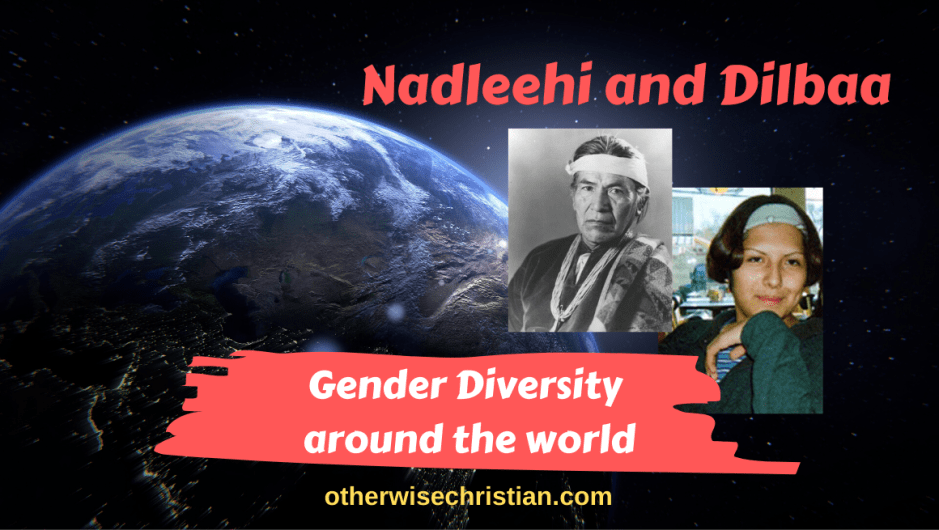
The traditional culture of the Diné (commonly called the Navajo) has four genders. Although nadleehi and dilbaa are commonly used as examples in articles explaining two spirit expressions, they are specific to Diné culture.
I have been suspicious of how Diné gender identities are often described online and I had the opportunity to sort it out with Nick Manchester as we were preparing his article for OtherWise Christian 2: Stories of Resistance:
I want to talk about the hypocrisy of biblical literalism today, but, first, I want to get you caught up on the story of Joseph of Genesis. Peterson Toscano brought us one of the biggest breakthroughs in transgender biblical interpretation (ever) through his work on Transfigurations: Transgressing Gender in the Bible. If you already know about Joseph and his “princess dress,” then you can skip the next paragraph.
In Transfigurations, Peterson tells the story of Joseph (Genesis) through the eyes of his uncle, the uber-masculine Esau. While the live production has been retired, you can get it on DVD or streaming on Amazon. The excerpt about Joseph is even available as a YouTube video in support of the DVD.
To the best of my knowledge, this interpretation was first offered by Theodore W Jennings Jr in his 2005 book, Jacob’s Wound: Homoerotic Narrative in the Literature of Ancient Israel, but Peterson traveled the country (and the world) making this Good News known.
To my mind, the bottom line is that the most literal reading of Joseph’s coat is that it was a “princess dress.” The phrase is ketonet passim. In 2 Samuel 13:18, it literally says, a ketonet passim “was the kind of garment the virgin daughters of the king wore.” We don’t need queer theory or historical-critical exegesis. This is just plain and simple use of the Bible to interpret the Bible. This is a literal reading of the text.
Still, in online discussions of my work and Peterson’s work, I have repeatedly heard folk argue that this interpretation is not “credible.” Granted, there are other viable interpretations. It may have been a unisex royal cloak or an ornate garment with long sleeves, as scholars have long proposed. However, that less specific interpretation is not what 2 Samuel says. 2 Samuel 13:18 literally says that this cloak was a princess dress. It is a rare example of scripture specifically providing a definition. It is simple and straight forward.
Now often when we see masculine language in scripture, we take liberties to shift toward “brothers and sisters” or the people–to make the reading more gender inclusive. Masculine language has often served as a default and this is a legitimate shift from a masculine to a “unisex” reading.
Many languages have gender built into the language in this way. For instance in Spanish, hijos can mean “sons” or it can mean “children.” While the masculine reading is “literal,” it is an question of context and interpretation to decide when that masculine word indicates “sons” and when that masculine word means “children.” Hebrew operates similarly.
However, it really doesn’t work the other way! In Spanish, hijas always means daughters (never children of diverse genders). In Hebrew, feminine nouns are not used as generic, un-gendered words for people. In this text, it specifically says a ketonet passim is for the virgin daughters of a king. Virgin and daughter are both feminine words.
But they are not just feminine words. They are feminine words that really mean something in terms of gender, in terms of the power, significance, and care that are passed along to the children of royalty (in a variety of cultures). Virgin daughters would be available for a political marriage to a prince in another country as a way to secure an alliance. This availability was important and would often be made visible through clothing and jewelry, just a like a ring on a particular finger represents marriage in Western cultures.
There is plenty more to this text and to Joseph’s story, but the Bible literally says that the garment Jacob made for Joseph was a princess dress.
Still, people resist. There is a similar dynamic around eunuchs, where trans-antagonistic trolls (Christian or not) admonish transgender people to read Deuteronomy literally yet refuse to take the affirming words about eunuchs from Jesus in Matthew seriously. These are some of the most obvious examples, but the tendency is widespread.
For all the moaning about “biblical literalism,” anti-transgender forces pick and choose what passages to take literally and what passages to ignore as much as anyone does. Remember that “Because I Said So” is not a reasonable argument for a particular biblical interpretation. If someone is not willing to be consistent in their reading of the Bible, then there is good reason to suspect their motives.
Obviously, we have all been conditioned to read the Bible in “traditional” ways. That is, in accordance with the ways we were taught to read it by others. Just remember that those “traditions” also include white supremacy, anti-Semitism, and gender oppression. They are perspectives shaped by human readers who themselves had an “agenda” — even if it was simply an agenda to make Bible characters look more like the cisgender, heterosexual, men that they were most familiar with.
Note: This blog is intended to be an on-going work in progress. Please contact us if you have corrections or are able to contribute further context or reflections.
You may have noticed that my blog has been quiet for a couple of months. It wasn’t a big plan, but I did get distracted by several other projects and then found that I needed some time to hibernate. However, I am coming back and here is some of what I have been up to!
Thank you to Will O’Brien and Lydia Wylie-Kellerman for suggesting that I write for the Radical Discipleship blog! This is a blog connected to many of the communities that were also connected to The Witness magazine as well as The Other Side magazine. In other words, (primarily) Christian folk who care about the Bible and justice. This is in some ways a circling back for me, since I worked at The Other Side magazine for nearly 10 years and the folk at The Witness were colleagues and friends.
Content warning:This series of self-defense posts will necessarily rehearse some trans-antagonistic perspectives for the sake of developing trans-affirming responses.
A lot of trans-antagonistic arguments are not about the Bible at all. They are often about the many cultural assumptions that we bring to the conversation.
On a recent Facebook thread, trolls called me sick and sinful. They argued that I am lying to myself. They acted like they were talking from a Christian point-of-view (talking about heresy), but not once did they actually cite scripture or demonstrate any understanding of the ways of Jesus or the Love of God.
They seemed to rely on the idea that their unilateral proclamations would be sufficient to motivate my submission to their perspectives — or to otherwise condemn, hurt, or silence me (and others like me).
The more I testified about God, Jesus, and scripture, the more it became clear that their argument was basically just “You are not a (real) Christian, because (you are transgender and) I said so.” There wasn’t much substance beyond their confident declarations.
The muxes are a kind of gender diversity found primarily in rural Mexico, specifically in southern Oaxaca among the Zapotec people. They are assigned male at birth, but express themselves in feminine ways. Some muxe identify as men, some as women, and some as simply muxe.
The Zapotec language is gender-neutral, so there is no indigenous reason to force a specific gender on the muxe. The muxe identity is a part of Zapotec culture and does not translate neatly into the assumptions of other cultural contexts. The culture allows for some significant ambiguity in regards the the muxes, which is only amplified by globalization and contact with LGBT organizing outside of the region.
Even the Roman Catholic Church in that region accommodates the muxes. Legend suggests that the muxe are connected to Saint Vicente Ferrer, but muxes are actually believed to pre-date colonization. They play an important role in preparing fiestas.
The acceptance of muxes within Mexico is not universal. Bullying and discrimination remain an issue, despite high levels of acceptance in Oaxaca. Some muxe who have been rejected by their families in other parts of the country flock to Juchitán to experience acceptance.








 OtherWise Christian